Investment View
The Federal Reserve’s decision under Chairman Kevin Warsh to move away from explicit forward guidance represents an important shift in the monetary policy framework. Rather than signaling the likely path of policy rates, the Fed has adopted a more data-dependent approach, allowing financial markets to infer future policy decisions from incoming economic information.
While this change enhances policy flexibility, it also removes an important anchor that has helped stabilize financial markets since the Global Financial Crisis. As a result, investors should expect structurally higher volatility across both fixed income and equity markets.
Fixed Income: Higher Term Premiums Are Likely
For more than a decade, forward guidance compressed long-term bond yields by reducing uncertainty regarding future monetary policy. Without this communication tool, investors are likely to demand a higher term premium to compensate for increased uncertainty surrounding inflation and future policy decisions.
Consequently, long-term U.S. Treasury yields could remain biased to the upside even if the Federal Funds Rate changes only gradually. This represents a structural repricing rather than merely a cyclical adjustment
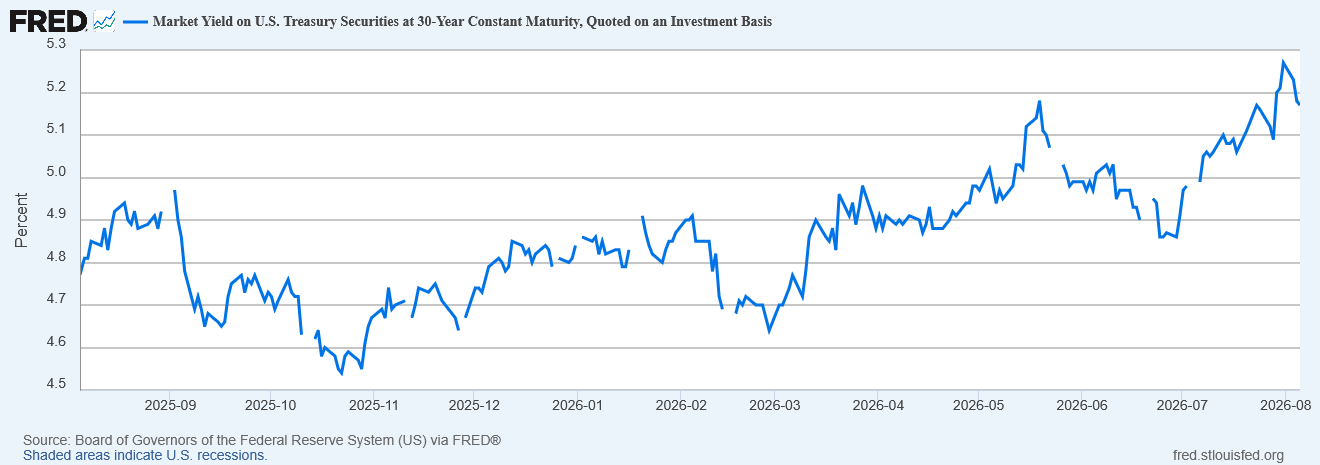
Figure 1. 30-Year U.S. Treasury Yield
Source: Board of Governors of the Federal Reserve System (U.S.), via FRED, Federal Reserve Bank of St. Louis.
As illustrated in the chart above, the yield on the 30-year U.S. Treasury bond has risen significantly. The risk is amplified by elevated U.S. government financing needs and persistent fiscal deficits. In such an environment, the Treasury market becomes increasingly sensitive to changes in investor confidence, inflation expectations, and policy credibility.
Our central scenario is not a disorderly bond market sell-off. Nevertheless, the probability of sharp yield adjustments has increased materially compared with recent years.
Equity Markets Face a More Challenging Environment
Higher sovereign bond yields create several headwinds for global equities.
First, rising real yields increase discount rates, placing downward pressure on equity valuations, particularly within long-duration growth sectors.
Second, higher financing costs gradually weigh on corporate earnings through increased interest expenses and reduced investment activity.
Third, less predictable monetary policy increases the equity risk premium as investors demand greater compensation for uncertainty
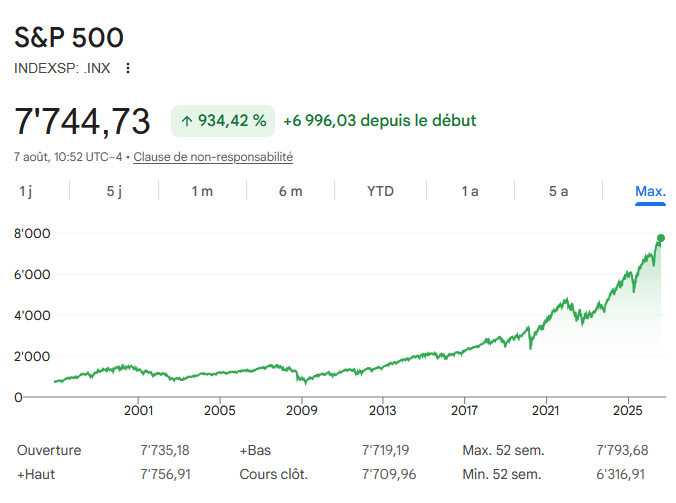
Figure 2. S&P 500 Index (long-term performance)
Source: Yahoo Finance.
Without forward guidance, equity valuations may become more vulnerable as bond yield volatility increases.
Taken together, these factors suggest that equity returns are likely to become more dependent on earnings quality and valuation discipline than on multiple expansion supported by abundant liquidity.
Investment Implications
We believe investors should prepare portfolios for a regime characterized by higher interest-rate volatility and greater market dispersion.
Within fixed income, duration should be managed actively, with a preference for intermediate maturities and high-quality issuers until greater clarity on the long-term interest-rate outlook emerges.
Within equities, we favor companies with resilient cash flows, strong balance sheets and sustainable pricing power. Defensive quality sectors should continue to outperform businesses whose valuations rely heavily on distant future earnings.
Regional diversification remains important as monetary policy paths increasingly diverge across major central banks.
House view
The transition away from forward guidance marks the beginning of a new market regime rather than a temporary policy adjustment. Financial markets are likely to operate with less monetary certainty, higher term premiums and greater sensitivity to macroeconomic surprises.
While stronger economic fundamentals should continue to support long-term investment opportunities, investors should expect higher volatility to become a permanent feature of the investment landscape. Active portfolio management, disciplined risk control and selective security selection are therefore likely to generate increasing value over the coming years.
Our positioning remains cautiously constructive. We continue to favor high-quality assets, like equities with strong balance sheets and robust cash flow, maintain a shorter to neutral duration stance and emphasize diversified portfolios capable of navigating a more volatile and less predictable monetary policy environment.
August 7, 2026
Gian Heim, Founder and Portfolio Manager RESCAD SA
Some of our market comments and investment fund factsheets may be prepared with the assistance of AI tools, including ChatGPT, Anthropic and similar technologies.


